
EDUCATIONAL CONTAINER FARM FOR K-12 SCHOOLS

combined planting positions inside 40 FT Container
Up to 2,800 combined planting positions
High Cube educational container
Vertical towers + multi-level tray growing
Separate technical area
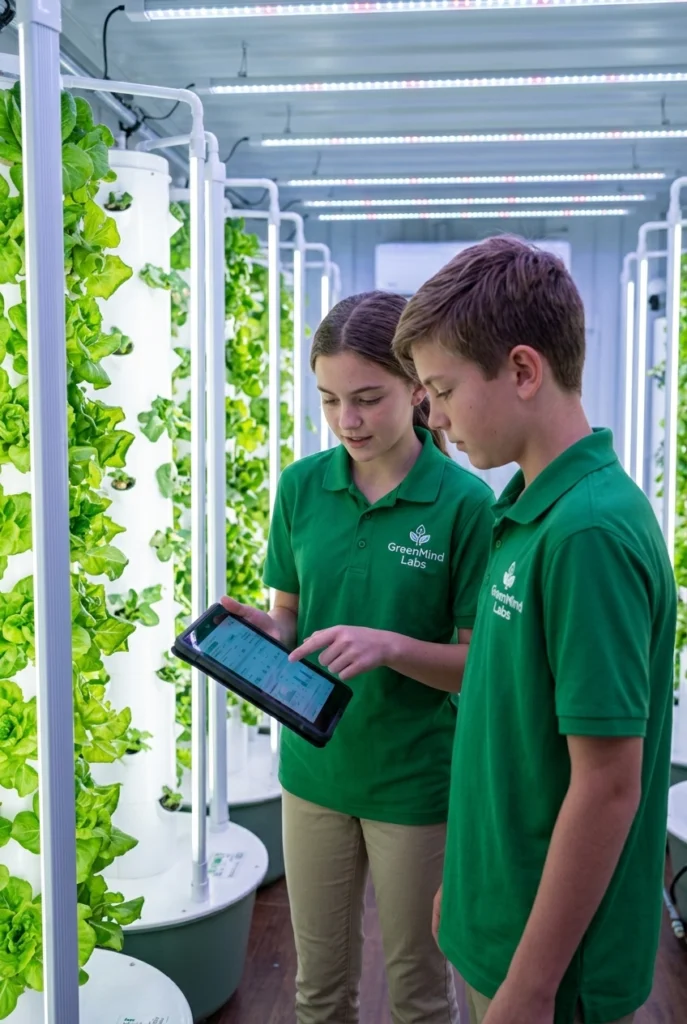
A controlled-environment hydroponic farm designed as a hands-on STEAM and agriculture laboratory. The system combines hydroponics, environmental controls, sensors, automation, LED grow lighting, water management, and data monitoring in one learning environment.
Hands-On STEAM Learning
The container farm turns classroom concepts into real experiments through a simple four-step cycle.
Understand the science.
Adjust variables and create experiments.
Manage real crops and systems.
Analyze results and compare outcomes.
Curriculum Integration
Photosynthesis, plant physiology, roots and growth cycles.
pH, EC, nutrients, solubility and water quality.
Water conservation, resource efficiency, sustainability and food systems.
Pumps, plumbing, HVAC, water flow, system design and maintenance.
Sensors, automation, monitoring systems, controls and data.
Growth rates, yield, measurements, graphs, statistics and comparisons.
Cost, budgeting, pricing, production planning, marketing and entrepreneurship.
Food security, service learning and community food access.
| LAB FEATURE |
K–8
Elementary / Middle School
|
STEM
High School STEM
|
|---|---|---|
| 01 Core growing layout | 10 vertical towers + five-level tray system | Same core growing layout |
| 02 Planting capacity | Up to 2,800 positions | Up to 2,800 positions |
| 03 Control | PLC + local touchscreen | Expanded PLC + advanced HMI |
| 04 Lighting experiments | Standard scheduling | Independent tower/tray zoning + dimming |
| 05 Experimental circuits | Core independent nutrient circuits | Additional dedicated experimental loops |
| 06 Data | Real-time operating status | Historical trends, experiment comparison, CSV export |
| 07 Additional sensors | Core environmental / EC / pH | PAR sensors + digital flow sensors |
| 08 Research tools | Standard | Data logger, growth camera, remote alarm/gateway |
The 40-ft Educational Container Farm is available in two configurations, each designed for a different level of student experimentation.
From first conversation to full operation – a clear, guided process.
Every system is built with student safety as a priority.
ADA/accessibility, ramps, fire sprinkler and local school-code requirements confirmed per project.
| ITEM | REQUIREMENT |
|---|---|
| 01 Recommended electrical service | 120/208 V, 3-phase, 4-wire + ground, 60 Hz, minimum 100 A |
| 02 Total design load | Approx. 20 kW |
| 03 Normal daily consumption | Approx. 150–200 kWh |
| 04 Average make-up water | Approx. 350–500 L/day |
| 05 Maximum design water allowance | 600 L/day |
| 06 Drainage | Internal floor drain, wastewater connection, HVAC condensate drain and nutrient overflow provisions |
Final utility, HVAC, code, accessibility, certification and site requirements are project-specific and confirmed during engineering.
Define the problem and ask the right question.
Develop an idea and make an educated guess.
Refine your approach and improve your strategy.
Put your plan into action and develop your project.
Collect data and measure your results.
Compare outcomes and analyze the differences.
Share your findings and what you learned.
Help schools connect the farm with classroom learning.
Students interact with real systems rather than only learning theory.
A controlled-environment hydroponic system combining agriculture, engineering, technology and data.
Classes, clubs, experiments, research, sustainability, service learning and entrepreneurship.
More than an indoor farm. A connected learning platform.
Students can observe and interact with real controlled-environment agriculture systems – from hydroponics and LED lighting to climate control, water recirculation, sensors, nutrient management and automation. Teachers can use live operating data to connect plant science with engineering, chemistry, mathematics and technology.
Get Started
Bring food, science and technology together – right on your campus. Reach out and we’ll help you find the right fit for your school.